Why Somatic Art Works: What Your Body Just Did (And Why It Matters)
Companion to: When Grief Feels Heavy — A Neurographic Somatic Art Practice for Overwhelm & Healing
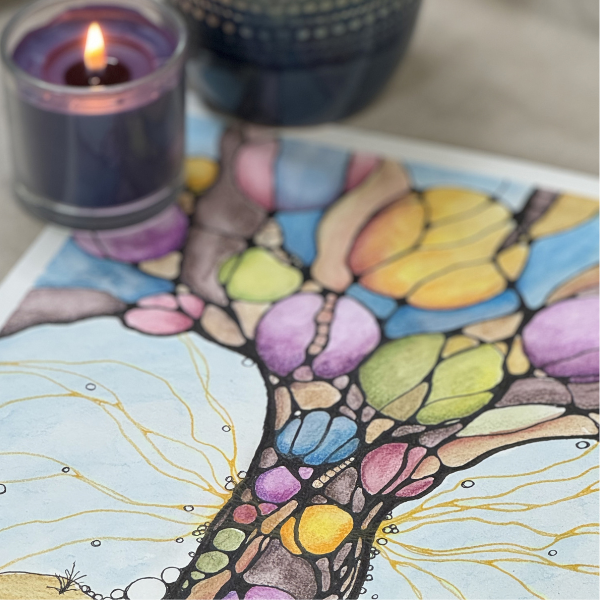
Somatic Art is the language of a Lived Experience
If you just came from the video — welcome. Come in. Sit for a moment.
Maybe you're here because something shifted during that practice and you want to understand it better. Maybe you're a person who needs to know the why before you can fully trust the what. Maybe you're simply curious about what just happened in your body when you picked up a pen and followed a feeling onto a page.
All of that makes sense. This post is for you.
I want to tell you what happened — not in the language of textbooks, but in the language of lived experience. Because what somatic art does is not complicated. It's actually very, very old.
The Body Holds What the Mind Can't Process
Grief is heavy for a reason.
When we experience loss — of a person, a relationship, a version of ourselves, a dream we didn't know we were still carrying — the body responds before the mind does. The chest tightens. The throat closes. The shoulders round inward, as if protecting something tender.
This isn't weakness. It's intelligence. The body is doing exactly what it's designed to do: holding the experience until we're ready to process it.
The trouble is, we often never give it permission to release. We push through. We stay busy. We tell ourselves we should be over it by now. And the heaviness stays — sometimes for years — because it was never given a place to go.
Somatic art gives it somewhere to go.
What the Breath Did
We began with three rounds of intentional breathing — a counted inhale, a gentle hold, and an exhale twice as long.
That long, slow exhale is doing something very specific.
When we exhale slowly and completely, the body receives a signal that it is safe. Not metaphorically safe — physically safe, at the level of the nervous system. The long exhale is one of the fastest ways we can move ourselves from a state of tension and vigilance into a state of openness and rest. It requires no special equipment, no training, no quiet room. Just breath. Just intention.
By the time we finished the third round, your body had already begun to soften — before a single mark was made.
What Orienting to the Page Did
Before the first line, I asked you to run your fingertips across the paper.
That small act — feeling the texture, the edges, the weight of the page — is called orienting. It's a way of bringing your attention fully into the present moment by making contact with something real and physical.
When we're grieving, the mind tends to live in the past (replaying what we lost) or the future (dreading what comes next). Orienting gently interrupts that pattern. It brings you here. To this surface. To this moment. To these hands.
It sounds simple. It is simple. And it works.
The Small Act Of Orienting-
Simply brings us to the present moment.
What the Lines Did
The first marks we made were slow, continuous, unplanned. No destination. No shape in mind. Just the pen moving across the page, following whatever impulse arose.
This kind of mark-making — slow, rhythmic, without a fixed outcome — has a quieting effect on the part of us that is always planning, evaluating, and solving. When the hand is moving and the outcome is unknown, something in us relaxes its grip.
And then, from those unplanned lines, something began to emerge.
A tree.
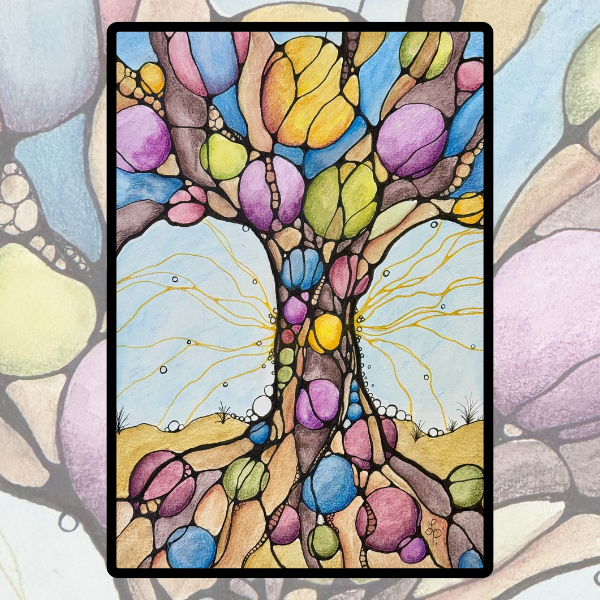
Not drawn — arrived. The roots finding their way down toward the bottom of the page. The trunk rising into the present moment. The branches reaching toward something not yet named. We didn't construct it. We let it come through. And that distinction is everything in somatic art. The thinking mind constructs. The sensing body reveals.
Once the tree had its shape, we placed circles within it. Named things. Real things.
In the roots — what lives beneath the surface. The emotions we carry without always saying out loud. Sadness. Anger. Exhaustion. The places where we've lost our footing. Each one given a closed shape, a boundary, a place to exist that isn't inside the chest.
In the trunk — resources. What is available right now, in this present moment, even in the middle of the hard. The things that are holding us even when we don't feel held.
In the canopy — hopes. Wishes. The fruit the tree is still capable of bearing. Each circle a named possibility reaching toward light.
There is something quietly profound about making the invisible visible. Grief, when it lives only inside us, can feel boundless — too large, too formless to hold. When it finds its way onto a page, it has edges. It has a shape. It becomes something we can look at, rather than something that looks at us.
What the Softening Did
This is the part I love most to talk about.
In the Neurographica-inspired approach, we round off every sharp corner — every place where two lines cross or meet. It's a small motion. Repetitive. Gentle.
And it teaches the nervous system something.
When we practice offering ease wherever there is tension — even in something as small as a line on a page — we are rehearsing a way of moving through the world. The hands learn it first. The body follows. Over time, we find ourselves doing the same thing with our emotions: meeting the sharp edges with a little more softness. Not forcing a resolution. Just rounding the corner.
It is, perhaps, the most somatic thing we do in the whole practice.
What the Color Did
When we moved into color, something shifted again.
Color carries emotion in a way that line alone cannot. And choosing intuitively — not the right color, not the color grief is supposed to be, but the color it is for you right now — asks the body rather than the mind to make a decision.
In my tree, I found myself reaching for browns first. Not because trees are brown, but because brown felt like grounding. Like being held by the earth before anything else could happen.
Then I moved into the root circles. Red arrived for the anger. Blue for the sadness. Green for the place where I'd lost my footing.
And then — purple. I wasn't expecting it. It arrived quietly, the way compassion often does. Maybe for the people I was grieving. Maybe, if I'm honest, for myself.
As I worked upward through the trunk and into the canopy, the purple kept returning. And yellow began to rise alongside it. The yellow felt like hope. Not a loud hope — a quiet one. The kind that doesn't announce itself until you're already feeling it.
By the time I reached the canopy, something had changed in the colors themselves. They were lighter. Greener. More open. And the blue — the blue that had held my sadness in the roots — had moved entirely outside the tree. Into the sky.
I didn't plan that. It just happened.
That is what intuitive color does. It tells you things you didn't know you needed to say.
What do your colors feel like? What did they do that you weren't expecting?
What the Whole Practice Did
By the time you set your pen and brushes down, your body had moved through something.
Not resolved it — grief doesn't resolve in fifteen minutes, and we wouldn't want to pretend otherwise. But moved through something. Created a little more space. Given the heaviness a home outside of you, where you can look at it, sit with it, and begin — gently, in your own time — to understand what it needs.
That is the gift of somatic art. Not answers. Not healing on a timeline. Just a practice of showing up for yourself, with a page and a pen, and saying:
I'm here. I'm listening. Let's see what needs to come through.
Want to Continue This Practice?
If this resonated with you, I'd love to have you in the Luminous Soul Art Circle — a community where we do exactly this kind of work together. There's a free way to participate and a deeper supported space if you're called to that.
The Link is here => Luminous Soul Art Circle
And if you haven't watched the video yet, you can find it here:
[INSERT YOUTUBE VIDEO LINK]
New somatic art practices arrive regularly here and on the channel. If this one found you at the right moment — trust that. Come back when you need it. Bring your pen. The page will be ready.
Take good care of yourself.
Laurie